
Bằng cách đổi biến số $t=1+\ln x$ thì tích phân $\displaystyle\displaystyle\int\limits_1^\mathrm{e}\dfrac{(1+\ln x)^2}{x}\mathrm{\,d}x$ trở thành
 | $\displaystyle\displaystyle\int\limits_1^\mathrm{e}t^2\mathrm{\,d}t$ |
 | $\displaystyle\displaystyle\int\limits_1^2t^2\mathrm{\,d}t$ |
 | $\displaystyle\displaystyle\int\limits_1^4t^2\mathrm{\,d}t$ |
 | $\displaystyle\displaystyle\int\limits_1^2(1+t)^2\mathrm{\,d}t$ |

Tính tích phân \(I=\displaystyle\int\limits_{1}^{\mathrm{e}}\dfrac{\sqrt{2+\ln x}}{2x}\mathrm{\,d}x\).
| \(\dfrac{3\sqrt{3}+2\sqrt{2}}{3}\) |
| \(\dfrac{\sqrt{3}+\sqrt{2}}{3}\) |
| \(\dfrac{\sqrt{3}-\sqrt{2}}{3}\) |
| \(\dfrac{3\sqrt{3}-2\sqrt{2}}{3}\) |

Hàm số \(y=f(x)\) liên tục trên \([1;4]\) và thỏa mãn \(f(x)=\dfrac{f\left(2\sqrt{x}-1\right)}{\sqrt{x}}+\dfrac{\ln x}{x}\). Tính tích phân \(I=\displaystyle\int\limits_{3}^{4}f(x)\mathrm{\,d}x\).
| \(I=3+2\ln^22\) |
| \(I=\ln^2\) |
| \(I=2\ln2\) |
| \(I=2\ln^22\) |
Tích phân \(I=\displaystyle\int\limits_0^1\dfrac{\left(x-1\right)^2}{x^2+1}\mathrm{\,d}x=a-\ln b\), trong đó \(a,\,b\) là các số nguyên. Tính giá trị của biểu thức \(a+b\).
| \(1\) |
| \(0\) |
| \(-1\) |
| \(3\) |
Biết rằng \(\displaystyle\int\limits_2^7\dfrac{x\mathrm{\,d}x}{x^2+1}=a\ln2-b\ln5\) với \(a,\,b\in\Bbb{Q}\). Giá trị của \(2a+b\) bằng
| \(\dfrac{3}{2}\) |
| \(\dfrac{1}{2}\) |
| \(1\) |
| \(2\) |
Cho \(\displaystyle\int\limits_{\tfrac{\pi}{6}}^{\tfrac{\pi}{2}}\dfrac{\cos x}{\sin x+1}\mathrm{\,d}x=a\ln2+b\ln3\) (\(a,\,b\in\mathbb{Z}\)). Khi đó, giá trị của \(a\cdot b\) là
| \(2\) |
| \(-2\) |
| \(-4\) |
| \(3\) |
Cho \(\displaystyle\int\limits_{0}^{\tfrac{\pi}{2}}\dfrac{\cos x}{\left(\sin x\right)^2-5\sin x+6}\mathrm{\,d}x=a\ln\dfrac{4}{c}+b\), với \(a,\,b\) là các số hữu tỉ, \(c>0\). Tính tổng \(S=a+b+c\).
| \(S=3\) |
| \(S=4\) |
| \(S=0\) |
| \(S=1\) |
Tính \(I=\displaystyle\int\limits_{\mathrm{e}}^{\mathrm{e}^2}\dfrac{\left(1-\ln x\right)^2}{x}\mathrm{\,d}x\) được kết quả là
| \(\dfrac{4}{3}\) |
| \(\dfrac{5}{3}\) |
| \(\dfrac{1}{3}\) |
| \(\dfrac{13}{3}\) |
Cho hàm số bậc bốn $y=f(x)$. Biết rằng hàm số $g(x)=\ln f(x)$ có bảng biến thiên như sau:
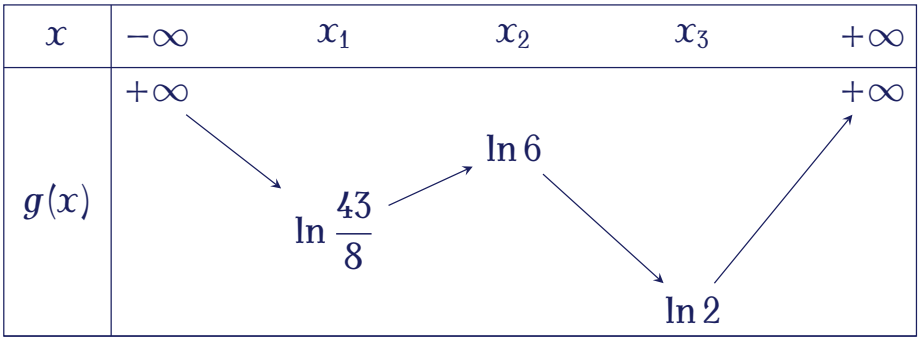
Diện tích hình phẳng giới hạn bởi các đường $y=f'(x)$ và $y=g'(x)$ thuộc khoảng nào dưới đây?
| $(5;6)$ |
| $(4;5)$ |
| $(2;3)$ |
| $(3;4)$ |
Cho tích phân $I=\displaystyle\displaystyle\int\limits_{0}^{1} x(1-x)^{2021}\mathrm{d}x$. Mệnh đề nào dưới đây đúng?
| $I=\displaystyle\displaystyle\int\limits_{0}^{1}t^{2021}(1-t)\mathrm{d}t$ |
| $I=-\displaystyle\displaystyle\int\limits_{-1}^{1}\left(t^{2022}-t^{2021}\right)\mathrm{d}t$ |
| $I=-\displaystyle\int\limits_{0}^{1} t^{2021}(1-t)\mathrm{d}t$ |
| $I=-\displaystyle\int\limits_{-1}^{1}\left(t^{2022}-t^{2021}\right)\mathrm{d}t$ |
Cho hàm số $f(x)$ liên tục trên $\mathbb{R}$ thỏa $\displaystyle\displaystyle\int\limits_{0}^{1}f(x)\mathrm{d}x=2$ và $\displaystyle\displaystyle\int\limits_{0}^2f(3x+1)\mathrm{d}x=6$. Tính $I=\displaystyle\displaystyle\int\limits_{0}^{7}f(x)\mathrm{d}x$.
| $I=20$ |
| $I=8$ |
| $I=18$ |
| $I=16$ |
Cho $\displaystyle\displaystyle\int\limits_{4}^{9}f(x)\mathrm{d}x=10$. Tính tích phân $J=\displaystyle\displaystyle\int\limits_{0}^{1}f(5x+4)\mathrm{d}x$.
| $J=2$ |
| $J=10$ |
| $J=50$ |
| $J=4$ |
Tính nguyên hàm $\displaystyle\displaystyle\int\dfrac{\left(\ln x+2\right)\mathrm{d}x}{x\ln x}$ bằng cách đặt $t=\ln x$ ta được nguyên hàm nào sau đây?
| $\displaystyle\displaystyle\int\dfrac{t\mathrm{\,d}t}{t-2}$ |
| $\displaystyle\displaystyle\int(t+2)\mathrm{\,d}t$ |
| $\displaystyle\displaystyle\int\left(1+\dfrac{2}{t}\right)\mathrm{\,d}t$ |
| $\displaystyle\displaystyle\int\dfrac{(t+2)\mathrm{\,d}t}{t^2}$ |
Biết $f\left(x\right)$ là hàm số liên tục trên $\mathbb{R}$ và $\displaystyle\displaystyle\int\limits_{0}^{9}f\left(x\right)\mathrm{d}x=9$. Khi đó tính $I=\displaystyle\displaystyle\int\limits_{2}^{5}f\left(3x-6\right)\mathrm{d}x$.
| $I=27$ |
| $I=24$ |
| $I=3$ |
| $I=0$ |
Nếu $\displaystyle\displaystyle\int\limits_1^3f(x)\mathrm{\,d}x=3$ thì $\displaystyle\displaystyle\int\limits_1^5f\left(\dfrac{x+1}{2}\right)\mathrm{\,d}x$ bằng
| $\dfrac{3}{2}$ |
| $3$ |
| $\dfrac{5}{2}$ |
| $6$ |
Biết $\displaystyle\displaystyle\int\limits_{-1}^1\left(\dfrac{9}{x-3}-\dfrac{7}{x-2}\right)\mathrm{\,d}x=a\ln{3}-b\ln{2}$. Tính giá trị $P=a^2+b^2$.
| $P=32$ |
| $P=130$ |
| $P=2$ |
| $P=16$ |
Biết $\displaystyle\displaystyle\int\limits_0^1x\sqrt{x^2+4}\mathrm{\,d}x=\dfrac{1}{a}\left(\sqrt{b^3}-c\right)$. Tính $Q=abc$.
| $Q=120$ |
| $Q=15$ |
| $Q=-120$ |
| $Q=40$ |
Cho hàm số $f(x)$ liên tục trên $\mathbb{R}$ và $\displaystyle\displaystyle\int\limits_{0}^{4}f(x)\mathrm{\,d}x=2020$. Giá trị của $\displaystyle\displaystyle\int\limits_{0}^{2}xf\left(x^2\right)\mathrm{\,d}x$ bằng
| $1008$ |
| $4040$ |
| $1010$ |
| $2019$ |
Nếu đặt $u=2x+1$ thì $\displaystyle\displaystyle\int\limits_{0}^{1}(2x+1)^4\mathrm{\,d}x$ bằng
| $\dfrac{1}{2}\displaystyle\displaystyle\int\limits_{1}^{3}u^4\mathrm{\,d}u$ |
| $\displaystyle\displaystyle\int\limits_{1}^{3}u^4\mathrm{\,d}u$ |
| $\dfrac{1}{2}\displaystyle\displaystyle\int\limits_{0}^{1}u^4\mathrm{\,d}u$ |
| $\displaystyle\displaystyle\int\limits_{0}^{1}u^4\mathrm{\,d}u$ |
Cho hàm số $y=f(x)$ liên tục trên khoảng $(0;+\infty)$. Biết $f(1)=1$ và $f(x)=xf'(x)+\ln x$, $\forall x\in(0;+\infty)$. Giá trị của $f(\mathrm{e})$ bằng
| $\mathrm{e}$ |
| $\dfrac{1}{\mathrm{e}}$ |
| $1$ |
| $2$ |