
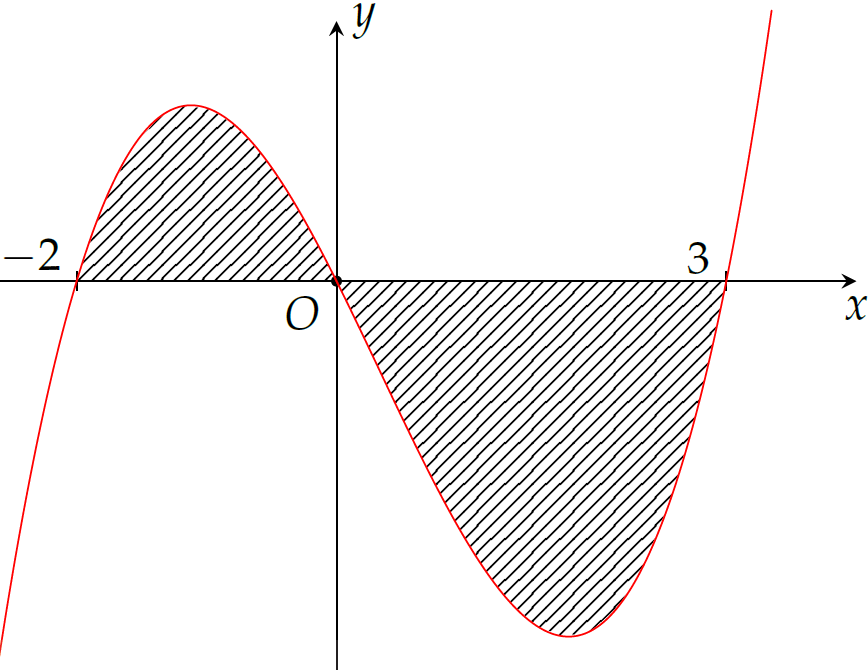
Cho đồ thị hàm số \(y=f(x)\) như hình vẽ và \(\displaystyle\int\limits_{-2}^{0}f(x)\mathrm{\,d}x=a\), \(\displaystyle\int\limits_{0}^{3}f(x)\mathrm{\,d}x=b\). Tính diện tích của phần được gạch chéo theo \(a\) và \(b\).
 | \(\dfrac{a+b}{2}\) |
 | \(a-b\) |
 | \(b-a\) |
 | \(a+b\) |

Cho hàm số \(f(x)\) liên tục trên đoạn \([a;b]\). Diện tích hình phẳng giới hạn bởi đường cong \(y=f(x)\), trục hoành, các đường thẳng \(x=a\), \(x=b\) là
| \(\displaystyle\int\limits_{b}^{a}f(x)\mathrm{\,d}x\) |
| \(\displaystyle\int\limits_{a}^{b}f(x)\mathrm{\,d}x\) |
| \(\displaystyle\int\limits_{a}^{b}\left|f(x)\right|\mathrm{\,d}x\) |
| \(-\displaystyle\int\limits_{a}^{b}f(x)\mathrm{\,d}x\) |
Một ô tô đang đi với vận tốc lớn hơn \(72\)km/h, phía trước là đoạn đường chỉ cho phép chạy với tốc độ tối đa là \(72\)km/h, vì thế người lái xe đạp phanh để ô tô chuyển động chậm dần đều với vận tốc \(v(t)=30-2t\) (m/s), trong đó \(t\) là khoảng thời gian tính bằng giây kể từ lúc bắt đầu đạp phanh. Hỏi từ lúc bắt đầu đạp phanh đến lúc đạt tốc độ \(72\)km/h, ô tô đã di chuyển quãng đường là bao nhiêu mét?
| \(100\)m |
| \(150\)m |
| \(175\)m |
| \(125\)m |
Giá trị nào của \(a\) để $$\displaystyle\int\limits_{0}^{a}\left(3x^2+2\right)\mathrm{\,d}x=a^3+2?$$
| \(1\) |
| \(2\) |
| \(0\) |
| \(3\) |
Cho \(I=\displaystyle\int\limits_{1}^{2}x\sqrt{4-x^2}\mathrm{\,d}x\) và \(t=\sqrt{4-x^2}\). Khẳng định nào sau đây sai?
| \(I=\sqrt{3}\) |
| \(I=\dfrac{t^2}{2}\bigg|_0^{\sqrt{3}}\) |
| \(I=\displaystyle\int\limits_{0}^{\sqrt{3}}t^2\mathrm{\,d}t\) |
| \(I=\dfrac{t^3}{3}\bigg|_0^{\sqrt{3}}\) |
Tích phân \(I=\displaystyle\int\limits_{1}^{2}\left(x^2+\dfrac{x}{x+1}\right)\mathrm{\,d}x\) có giá trị là
| \(I=\dfrac{10}{3}+\ln2-\ln3\) |
| \(I=\dfrac{10}{3}+\ln2+\ln3\) |
| \(I=\dfrac{10}{3}-\ln2+\ln3\) |
| \(I=\dfrac{10}{3}-\ln2-\ln3\) |
Biết rằng tích phân \(\displaystyle\int\limits_{0}^{1}(2x+1)\mathrm{e}^x\mathrm{\,d}x=a+b\mathrm{e}\) với \(a,\,b\in\mathbb{Z}\). Tích \(ab\) bằng
| \(1\) |
| \(-1\) |
| \(-15\) |
| \(20\) |
Khẳng định nào sau đây đúng?
| \(\displaystyle\int\limits_{-2}^{2}f(x)\mathrm{\,d}x=-\displaystyle\int\limits_{0}^{2}\left[f(x)+f(-x)\right]\mathrm{\,d}x\) |
| \(\displaystyle\int\limits_{-2}^{2}f(x)\mathrm{\,d}x=-2\displaystyle\int\limits_{0}^{2}f(x)\mathrm{\,d}x\) |
| \(\displaystyle\int\limits_{-2}^{2}2f(x)\mathrm{\,d}x=2\displaystyle\int\limits_{-2}^{2}f(x)\mathrm{\,d}x\) |
| \(\displaystyle\int\limits_{-2}^{2}f(x)\mathrm{\,d}x=2\displaystyle\int\limits_{0}^{2}f(x)\mathrm{\,d}x\) |
Cho \(f(x)\) là hàm số chẵn trên \(\mathbb{R}\) thỏa mãn \(\displaystyle\int\limits_{-3}^{0}f(x)\mathrm{\,d}x=2\). Chọn mệnh đề đúng.
| \(\displaystyle\int\limits_{-3}^{3}f(x)\mathrm{\,d}x=4\) |
| \(\displaystyle\int\limits_{3}^{0}f(x)\mathrm{\,d}x=2\) |
| \(\displaystyle\int\limits_{0}^{3}f(x)\mathrm{\,d}x=-2\) |
| \(\displaystyle\int\limits_{-3}^{3}f(x)\mathrm{\,d}x=2\) |
Giả sử \(\displaystyle\int\limits_{0}^{9}f(x)\mathrm{\,d}x=37\) và \(\displaystyle\int\limits_{9}^{0}g(x)\mathrm{\,d}x=16\). Khi đó, \(I=\displaystyle\int\limits_{0}^{9}\left[2f(x)+3g(x)\right]\mathrm{\,d}x\) bằng
| \(122\) |
| \(26\) |
| \(143\) |
| \(58\) |
Biết \(\displaystyle\int f(u)\mathrm{\,d}u=F(u)+C\). Mệnh đề nào dưới đây đúng?
| \(\displaystyle\int f(2x-1)\mathrm{\,d}x=2F(2x-1)+C\) |
| \(\displaystyle\int f(2x-1)\mathrm{\,d}x=2F(x)-1+C\) |
| \(\displaystyle\int f(2x-1)\mathrm{\,d}x=\dfrac{1}{2}F(2x-1)+C\) |
| \(\displaystyle\int f(2x-1)\mathrm{\,d}x=F(2x-1)+C\) |
Tìm nguyên hàm của hàm số \(f(x)=x\mathrm{e}^x\).
| \(\displaystyle\int f(x)\mathrm{\,d}x=(x+1)\mathrm{e}^x+C\) |
| \(\displaystyle\int f(x)\mathrm{\,d}x=(x-1)\mathrm{e}^x+C\) |
| \(\displaystyle\int f(x)\mathrm{\,d}x=x\mathrm{e}^x+C\) |
| \(\displaystyle\int f(x)\mathrm{\,d}x=x^2\mathrm{e}^x+C\) |
Tìm hàm số \(F(x)\) biết \(F'(x)=\sin2x\) và \(F\left(\dfrac{\pi}{2}\right)=1\).
| \(F(x)=\dfrac{1}{2}\cos2x+\dfrac{3}{2}\) |
| \(F(x)=2x-\pi+1\) |
| \(F(x)=-\dfrac{1}{2}\cos2x+\dfrac{1}{2}\) |
| \(F(x)=-\cos2x\) |
Hàm số nào dưới đây là nguyên hàm của hàm số \(f(x)=\dfrac{1}{1-x}\)?
| \(F(x)=-\dfrac{1}{4}\ln|4-4x|+3\) |
| \(F(x)=-\ln|1-x|+4\) |
| \(F(x)=\ln|1-x|+2\) |
| \(F(x)=\dfrac{1}{2}\ln\left(x^2-2x+1\right)+5\) |
Tìm nguyên hàm của hàm số \(f(x)=5^x\).
| \(\displaystyle\int f(x)\mathrm{\,d}x=5^x\ln5+C\) |
| \(\displaystyle\int f(x)\mathrm{\,d}x=5^x+C\) |
| \(\displaystyle\int f(x)\mathrm{\,d}x=\dfrac{5^x}{\ln x}+C\) |
| \(\displaystyle\int f(x)\mathrm{\,d}x=\dfrac{5^x}{\ln5}+C\) |
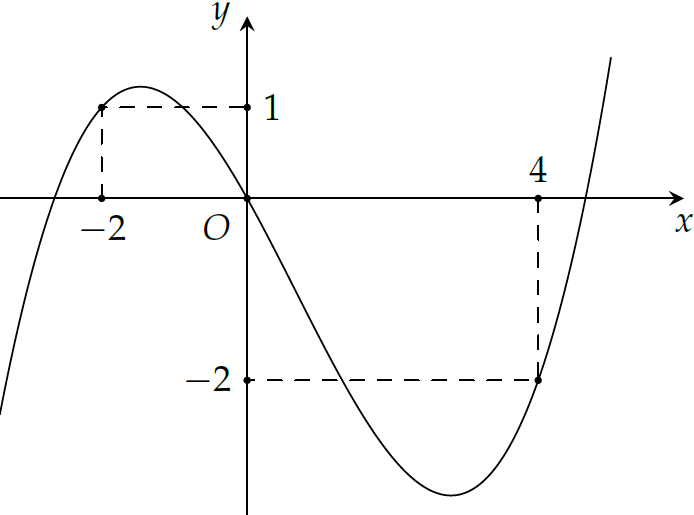
Cho hàm số \(f(x)\). Hàm số \(y=f'(x)\) có đồ thị như hình trên. Hàm số \(g(x)=f(1-2x)+x^2-x\) nghịch biến trên khoảng nào dưới đây?
| \(\left(1;\dfrac{3}{2}\right)\) |
| \(\left(0;\dfrac{1}{2}\right)\) |
| \(\left(-2;-1\right)\) |
| \(\left(2;3\right)\) |
Cho hàm số \(f(x)\) liên tục trên \(\mathbb{R}\) và thỏa mãn \(xf\left(x^3\right)+f\left(1-x^2\right)=-x^{10}+x^6-2x\), \(\forall x\in\mathbb{R}\). Khi đó \(\displaystyle\int\limits_{-1}^0f(x)\mathrm{\,d}x\) bằng
| \(-\dfrac{17}{20}\) |
| \(-\dfrac{13}{4}\) |
| \(\dfrac{17}{4}\) |
| \(-1\) |
Có bao nhiêu cặp số nguyên \((x;y)\) thỏa mãn \(0\leq x\leq2020\) và \(\log_3(3x+3)+x=2y+9^y\)?
| \(2019\) |
| \(6\) |
| \(2020\) |
| \(4\) |
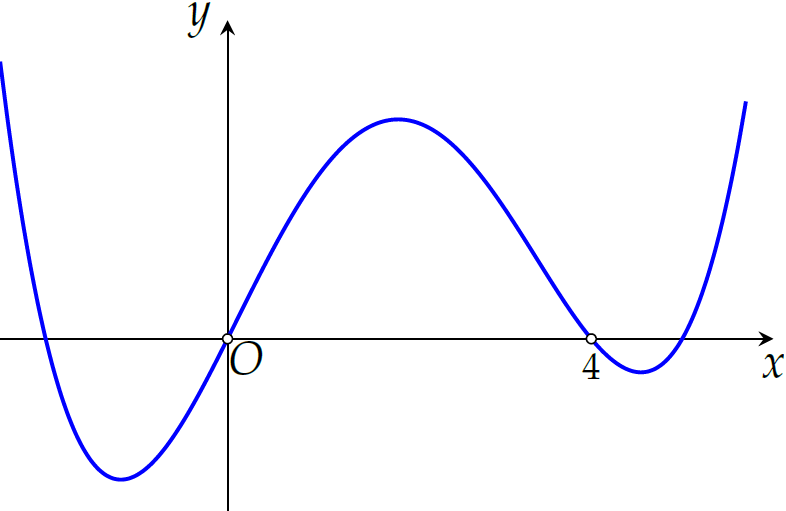
Cho hàm số bậc bốn \(y=f(x)\) có đồ thị như hình trên. Số điểm cực trị của hàm số \(g(x)=f\left(x^3+3x^2\right)\) là
| \(5\) |
| \(3\) |
| \(7\) |
| \(11\) |
Cho hàm số \(f(x)\) có bảng biến thiên như sau:
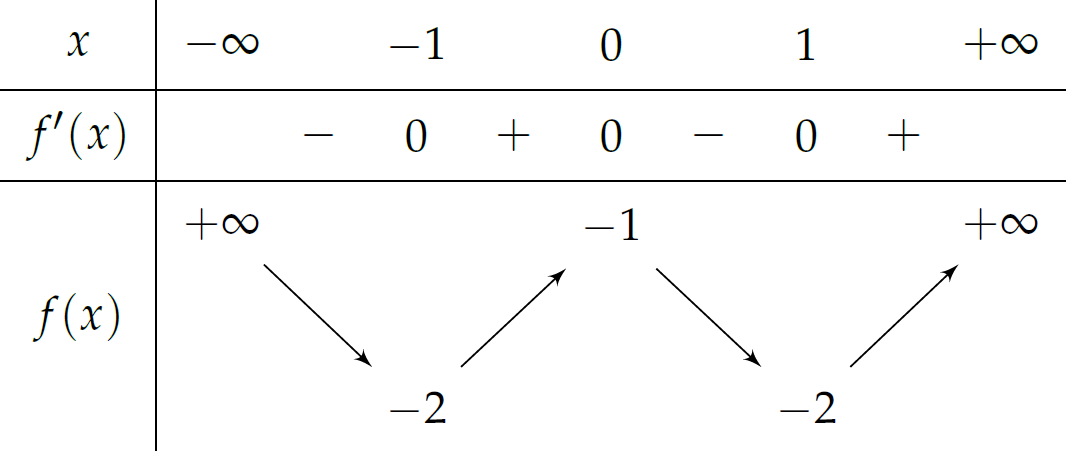
Số nghiệm thuộc đoạn \(\left[-\pi;2\pi\right]\) của phương trình \(2f\left(\sin x\right)+3=0\) là
| \(4\) |
| \(6\) |
| \(3\) |
| \(8\) |