
Nếu hàm số \(y=f(x)\) liên tục trên đoạn \([a;b]\) thì diện tích \(S\) của hình phẳng giới hạn bởi đồ thị hàm số \(y=f(x)\), trục hoành và hai đường thẳng \(x=a\), \(x=b\) là
 | \(\displaystyle\int\limits_{a}^{b}\left|f(x)-g(x)\right|\mathrm{\,d}x\) |
 | \(\displaystyle\int\limits_{b}^{a}\left|f(x)\right|\mathrm{\,d}x\) |
 | \(\displaystyle\int\limits_{a}^{b}f(x)\mathrm{\,d}x\) |
 | \(\displaystyle\int\limits_{a}^{b}\left|f(x)\right|\mathrm{\,d}x\) |

Hàm số \(y=f(x)\) liên tục trên \([1;4]\) và thỏa mãn \(f(x)=\dfrac{f\left(2\sqrt{x}-1\right)}{\sqrt{x}}+\dfrac{\ln x}{x}\). Tính tích phân \(I=\displaystyle\int\limits_{3}^{4}f(x)\mathrm{\,d}x\).
| \(I=3+2\ln^22\) |
| \(I=\ln^2\) |
| \(I=2\ln2\) |
| \(I=2\ln^22\) |
Cho hàm số \(y=f(x)\) liên tục, nhận giá trị dương trên \((0;+\infty)\) và thỏa mãn \(f(1)=1\), \(f(x)=f'(x)\sqrt{3x+1}\), với mọi \(x>0\). Mệnh đề nào sau đây đúng?
| \(4< f(5)<5\) |
| \(3< f(5)<4\) |
| \(1< f(5)<2\) |
| \(2< f(5)<3\) |
Cho \(\displaystyle\int\limits_{0}^{1}\dfrac{x^2+1}{x+1}\mathrm{\,d}x=a+b\ln c\), với \(a\in\mathbb{Q}\), \(b\in\mathbb{Z}\), \(c\) là số nguyên tố. Ta có \(2a+b+c\) bằng
| \(5\) |
| \(4\) |
| \(3\) |
| \(2\) |
Giả sử tích phân \(I=\displaystyle\int\limits_{1}^{6}\dfrac{1}{2x+1}\mathrm{\,d}x=\ln M\), tìm \(M\).
| \(M=13\) |
| \(M=4,33\) |
| \(M=\sqrt{\dfrac{13}{3}}\) |
| \(M=\dfrac{13}{3}\) |
Cho hàm số \(y=f(x)\) có đạo hàm \(f'(x)\) liên tục trên \([0;2]\) và \(f(2)=3\), \(\displaystyle\int\limits_{0}^{2}f(x)\mathrm{\,d}x=3\). Tính \(\displaystyle\int\limits_{0}^{2}x\cdot f'(x)\mathrm{\,d}x\).
| \(6\) |
| \(3\) |
| \(0\) |
| \(-3\) |
Giá trị của tích phân \(\displaystyle\int\limits_{0}^{\tfrac{\pi}{4}}x\sin x\mathrm{\,d}x\) bằng
| \(\dfrac{4+\pi}{4\sqrt{2}}\) |
| \(\dfrac{4-\pi}{4\sqrt{2}}\) |
| \(\dfrac{2-\pi}{2\sqrt{2}}\) |
| \(\dfrac{2+\pi}{2\sqrt{2}}\) |
Cho hàm số \(y=f(x)\) có đạo hàm \(f'(x)=\dfrac{1}{2x-1}\) và \(f(1)=1\). Giá trị \(f(5)\) bằng
| \(1+\ln2\) |
| \(1+\ln3\) |
| \(\ln2\) |
| \(\ln3\) |
Cho hàm số \(f(x)\) có đạo hàm \(f'(x)\) liên tục trên \([a;b]\), \(f(b)=5\), \(\displaystyle\int\limits_{a}^{b}f'(x)\mathrm{\,d}x=3\sqrt{5}\). Tính \(f(a)\).
| \(f(a)=3\sqrt{5}\) |
| \(f(a)=\sqrt{5}\left(\sqrt{5}-3\right)\) |
| \(f(a)=\sqrt{3}\left(\sqrt{5}-3\right)\) |
| \(f(a)=\sqrt{5}\left(3-\sqrt{5}\right)\) |
Cho hàm số \(f(x),\,g(x)\) liên tục trên \([a;b]\). Khẳng định nào sau đây sai?
| \(\displaystyle\int\limits_{a}^{b}\left[f(x)+g(x)\right]\mathrm{\,d}x=\displaystyle\int\limits_{a}^{b}f(x)\mathrm{\,d}x+\displaystyle\int\limits_{a}^{b}g(x)\mathrm{\,d}x\) |
| \(\displaystyle\int\limits_{a}^{b}f(x)\mathrm{\,d}x=\displaystyle\int\limits_{b}^{a}f(x)\mathrm{\,d}x\) |
| \(\displaystyle\int\limits_{a}^{b}f(x)\mathrm{\,d}x=\displaystyle\int\limits_{a}^{b}f(t)\mathrm{\,d}t\) |
| \(\displaystyle\int\limits_{a}^{b}f(x)\mathrm{\,d}x=\displaystyle\int\limits_{c}^{b}f(x)\mathrm{\,d}x+\displaystyle\int\limits_{a}^{c}f(x)\mathrm{\,d}x\) |
Cho \(F(x)\) là một nguyên hàm của hàm số \(f(x)\). Khi đó hiệu số \(F(0)-F(1)\) bằng
| \(\displaystyle\int\limits_{0}^{1}-F(x)\mathrm{\,d}x\) |
| \(\displaystyle\int\limits_{0}^{1}F(x)\mathrm{\,d}x\) |
| \(-\displaystyle\int\limits_{0}^{1}f(x)\mathrm{\,d}x\) |
| \(\displaystyle\int\limits_{0}^{1}f(x)\mathrm{\,d}x\) |
Cho hàm số \(f(x)\) liên tục trên \(\mathbb{K}\) và \(a,\,b\in\mathbb{K}\), \(F(x)\) là một nguyên hàm của \(f(x)\) trên \(\mathbb{K}\). Chọn khẳng định sai trong các khẳng định sau.
| \(\displaystyle\int\limits_{a}^{b}f(x)\mathrm{\,d}x=F(a)-F(b)\) |
| \(\displaystyle\int\limits_{a}^{b}f(x)\mathrm{\,d}x=\displaystyle\int\limits_{a}^{b}f(t)\mathrm{\,d}t\) |
| \(\displaystyle\int\limits_{a}^{b}f(x)\mathrm{\,d}x=F(x)\bigg|_a^b\) |
| \(\displaystyle\int\limits_{a}^{b}f(x)\mathrm{\,d}x=\left(\displaystyle\int f(x)\mathrm{\,d}x\right)\bigg|_a^b\) |
Xét nguyên hàm \(I=\displaystyle\int x\sqrt{x+2}\mathrm{\,d}x\). Nếu đặt \(t=\sqrt{x+2}\) thì ta được
| \(I=\displaystyle\int\left(4t^4-2t^2\right)\mathrm{\,d}t\) |
| \(I=\displaystyle\int\left(t^4-2t^2\right)\mathrm{\,d}t\) |
| \(I=\displaystyle\int\left(2t^4-4t^2\right)\mathrm{\,d}t\) |
| \(I=\displaystyle\int\left(2t^4-t^2\right)\mathrm{\,d}t\) |
Họ nguyên hàm của hàm số \(f(x)=\sin3x\) là
| \(\dfrac{1}{3}\cos3x+C\) |
| \(-\dfrac{1}{3}\cos3x+C\) |
| \(-3\cos3x+C\) |
| \(3\cos3x+C\) |
Trong các mệnh đề sau, mệnh đề nào sai?
| \(\displaystyle\int3x^2\mathrm{\,d}x=x^3+C\) |
| \(\displaystyle\int\mathrm{e}^{2x}\mathrm{\,d}x=\dfrac{1}{2}\mathrm{e}^{2x}+C\) |
| \(\displaystyle\int\dfrac{1}{2x}\mathrm{\,d}x=\dfrac{\ln|x|}{2}+C\) |
| \(\displaystyle\int\sin2x\mathrm{\,d}x=2\cos2x+C\) |
Cho hình phẳng \(D\) giới hạn bởi đồ thị hàm số \(y=2x^2+3x\), trục \(Ox\) và hai đường thẳng \(x=0,\,x=1\). Tính thể tích \(V\) của khối tròn xoay được tạo thành khi quay \(D\) quanh trục \(Ox\).
| \(V=\dfrac{13}{6}\) |
| \(V=\dfrac{13\pi}{6}\) |
| \(V=\dfrac{34\pi}{5}\) |
| \(V=\dfrac{34}{5}\) |
Cho hình phẳng \(H\) giới hạn bởi đồ thị hàm số \(y=f(x)\) liên tục trên đoạn \([a;b]\), trục \(Ox\) và hai đường thẳng \(x=a,\,x=b\). Thể tích \(V\) của khối tròn xoay được tạo thành khi quay \(H\) quanh trục \(Ox\) là
| \(V=\pi\displaystyle\int\limits_a^b f(x)\mathrm{\,d}x\) |
| \(V=\displaystyle\int\limits_a^b|f(x)|\mathrm{\,d}x\) |
| \(V=\pi\displaystyle\int\limits_a^b f^2(x)\mathrm{\,d}x\) |
| \(V=\displaystyle\int\limits_a^b f^2(x)\mathrm{\,d}x\) |
Tính diện tích \(S\) của hình phẳng giới hạn bởi đồ thị hàm số \(y=x^2+x\) và đường thẳng \(y=-x+3\).
| \(S=-\dfrac{32}{3}\) |
| \(S=\dfrac{16}{3}\) |
| \(S=16\) |
| \(S=\dfrac{32}{3}\) |
Tính diện tích \(S\) của hình phẳng giới hạn bởi đồ thị hàm số \(y=3^x\), trục \(Ox\) và hai đường thẳng \(x=-1\), \(x=2\).
| \(S=\dfrac{26}{3}\) |
| \(S=12\) |
| \(S=\dfrac{12}{\ln3}\) |
| \(S=\dfrac{26}{3\ln3}\) |
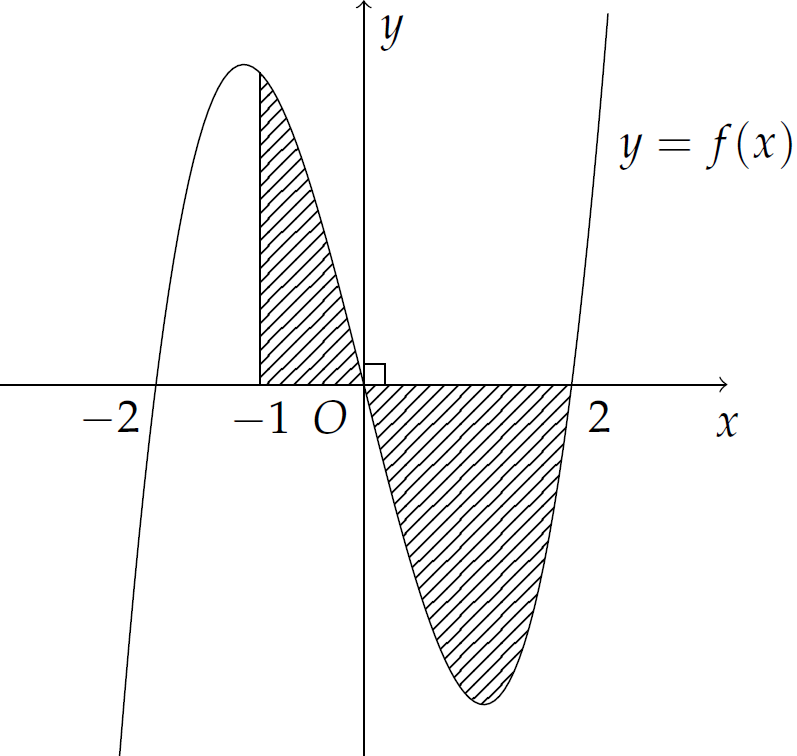
Cho hình phẳng \(H\) giới hạn bởi đồ thị hàm số \(y=f(x)\) trục \(Ox\) và đường thẳng \(x=-1\) (phần gạch sọc như hình trên). Gọi \(S\) là diện tích của hình phẳng \(H\). Mệnh đề nào dưới đây đúng?
| \(S=\displaystyle\int\limits_{-1}^0|f(x)|\mathrm{\,d}x-\displaystyle\int\limits_0^2|f(x)|\mathrm{\,d}x\) |
| \(S=\displaystyle\int\limits_{-1}^2f(x)\mathrm{\,d}x\) |
| \(S=\displaystyle\int\limits_{-1}^0f(x)\mathrm{\,d}x-\displaystyle\int\limits_0^2f(x)\mathrm{\,d}x\) |
| \(S=\displaystyle\int\limits_{-1}^0f(x)\mathrm{\,d}x+\displaystyle\int\limits_0^2f(x)\mathrm{\,d}x\) |