
Thể tích của khối tròn xoay tạo thành khi quay hình phẳng \(D\) giới hạn bởi các đường \(y=\sqrt{x-1}\), trục hoành, \(x=2\) và \(x=5\) quanh trục \(Ox\) bằng
 | \(\displaystyle\int\limits_{2}^{5}(x-1)\mathrm{\,d}x\) |
 | \(\displaystyle\int\limits_{2}^{5}\sqrt{x-1}\mathrm{\,d}x\) |
 | \(\pi\displaystyle\int\limits_{2}^{5}(x-1)\mathrm{\,d}x\) |
 | \(\pi^2\displaystyle\int\limits_{2}^{5}(x-1)\mathrm{\,d}x\) |

Diện tích hình phẳng giới hạn bởi đồ thị hai hàm số \(y=x^2\) và \(y=x\) là
| \(1\) |
| \(\dfrac{3}{2}\) |
| \(\dfrac{1}{2}\) |
| \(\dfrac{1}{6}\) |
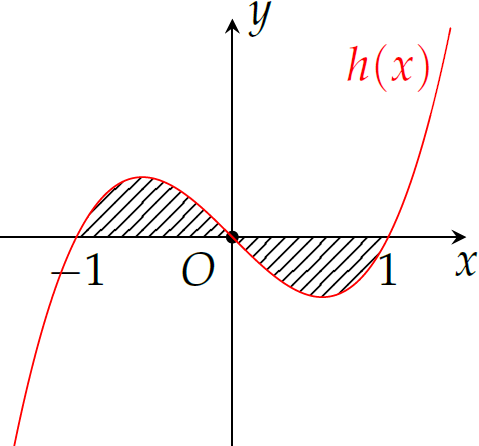
Cho đồ thị hàm số \(y=h(x)\). Diện tích hình phẳng (phần gạch chéo trong hình vẽ) bằng
| \(\displaystyle\int\limits_{-1}^{0}h(x)\mathrm{\,d}x+\displaystyle\int\limits_{0}^{1}h(x)\mathrm{\,d}x\) |
| \(\displaystyle\int\limits_{-1}^{1}h(x)\mathrm{\,d}x\) |
| \(\displaystyle\int\limits_{-1}^{0}h(x)\mathrm{\,d}x+\displaystyle\int\limits_{1}^{0}h(x)\mathrm{\,d}x\) |
| \(-\displaystyle\int\limits_{-1}^{0}h(x)\mathrm{\,d}x+\displaystyle\int\limits_{0}^{1}h(x)\mathrm{\,d}x\) |
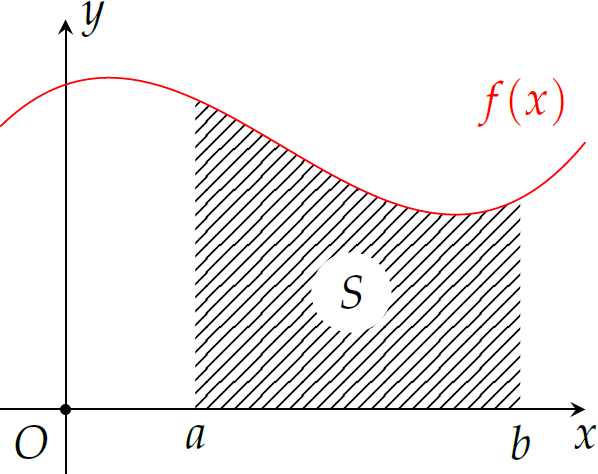
Diện tích hình phẳng \(S\) đối với hình vẽ trên là
| \(S=-\displaystyle\int\limits_{a}^{b}f(x)\mathrm{\,d}x\) |
| \(S=\displaystyle\int\limits_{a}^{b}f(x)\mathrm{\,d}x\) |
| \(S=\displaystyle\int\limits_{b}^{a}f(x)\mathrm{\,d}x\) |
| \(S=\displaystyle\int\limits_{a}^{b}-f(x)\mathrm{\,d}x\) |
Biết rằng \(\displaystyle\int\limits_{1}^{5}\dfrac{3}{x^2+3x}\mathrm{\,d}x=a\ln5+b\ln2\), (\(a,\,b\in\mathbb{Z}\)). Mệnh đề nào sau đây đúng?
| \(a+b=0\) |
| \(a-b=0\) |
| \(a+2b=0\) |
| \(2a-b=0\) |
Cho \(\displaystyle\int\limits_{\tfrac{\pi}{6}}^{\tfrac{\pi}{2}}\dfrac{\cos x}{\sin x+1}\mathrm{\,d}x=a\ln2+b\ln3\) (\(a,\,b\in\mathbb{Z}\)). Khi đó, giá trị của \(a\cdot b\) là
| \(2\) |
| \(-2\) |
| \(-4\) |
| \(3\) |
Kết quả của phép tính tích phân \(\displaystyle\int\limits_{0}^{1}\ln(2x+1)\mathrm{\,d}x=a\ln3+b\), (\(a,\,b\in\mathbb{Q}\)) khi đó giá trị của \(ab^3\) bằng
| \(-\dfrac{3}{2}\) |
| \(3\) |
| \(1\) |
| \(\dfrac{3}{2}\) |
Cho \(I=\displaystyle\int\limits_{0}^{\tfrac{\pi}{2}}\sin2x\mathrm{\,d}x\), \(J=\displaystyle\int\limits_{0}^{\tfrac{\pi}{2}}\sin x\mathrm{\,d}x\). Trong các mệnh đề sau, mệnh đề nào đúng?
| \(I>J\) |
| \(I=J\) |
| \(I< J\) |
| \(I=2J\) |
Cho tích phân \(\displaystyle\int\limits_{0}^{3}\dfrac{x}{1+\sqrt{1+x}}\mathrm{\,d}x\) và đặt \(t=\sqrt{1+x}\). Mệnh đề nào sau đây đúng?
| \(\displaystyle\int\limits_{1}^{2}\left(t^2-1\right)\mathrm{\,d}t\) |
| \(\displaystyle\int\limits_{1}^{2}\left(2t^2+2t\right)\mathrm{\,d}t\) |
| \(\displaystyle\int\limits_{1}^{2}\left(t^2+t\right)\mathrm{\,d}t\) |
| \(\displaystyle\int\limits_{1}^{2}\left(2t^2-2t\right)\mathrm{\,d}t\) |
Biết \(\displaystyle\int\limits_{1}^{2}f(x)\mathrm{\,d}x=2\) và \(\displaystyle\int\limits_{1}^{3}f(x)\mathrm{\,d}x=3\). Kết quả \(\displaystyle\int\limits_{3}^{2}f(x)\mathrm{\,d}x\) bằng bao nhiêu?
| \(3\) |
| \(\dfrac{5}{2}\) |
| \(-1\) |
| \(1\) |
Với \(a\neq0\). Cho biểu thức \(B=\displaystyle\int\limits_{-1}^{1}ax^2\mathrm{\,d}x\). Khẳng định nào sau đây sai?
| \(B=a\displaystyle\int\limits_{-1}^{1}x^2\mathrm{\,d}x\) |
| \(B=-\displaystyle\int\limits_{1}^{-1}ax^2\mathrm{\,d}x\) |
| \(B=\displaystyle\int\limits_{1}^{0}ax^2\mathrm{\,d}x+\displaystyle\int\limits_{0}^{-1}ax^2\mathrm{\,d}x\) |
| \(B=\dfrac{2a}{3}\) |
Giả sử hàm số \(f\) liên tục trên khoảng \(\mathbb{K}\) và \(a,\,b,\,c\) là \(3\) số thực bất kỳ thuộc \(\mathbb{K}\). Khẳng định nào sau đây sai?
| \(\displaystyle\int\limits_{a}^{b}f(x)\mathrm{\,d}x\neq\displaystyle\int\limits_{a}^{b}f(t)\mathrm{\,d}t\) |
| \(\displaystyle\int\limits_{a}^{b}f(x)\mathrm{\,d}x=-\displaystyle\int\limits_{b}^{a}f(t)\mathrm{\,d}t\) |
| \(\displaystyle\int\limits_{a}^{a}f(x)\mathrm{\,d}x=0\) |
| \(\displaystyle\int\limits_{a}^{b}f(x)\mathrm{\,d}x=\displaystyle\int\limits_{a}^{c}f(x)\mathrm{\,d}x+\displaystyle\int\limits_{c}^{b}f(x)\mathrm{\,d}x\;\left(c\in(a;b)\right)\) |
\(F(x)\) là một nguyên hàm của hàm số \(f(x)=\cot x\) và \(F\left(\dfrac{\pi}{2}\right)=0\). Giá trị của \(F\left(\dfrac{\pi}{6}\right)\) bằng
| \(-\ln\left(\dfrac{\sqrt{3}}{2}\right)\) |
| \(\ln\left(\dfrac{\sqrt{3}}{2}\right)\) |
| \(\ln2\) |
| \(-\ln2\) |
Cho \(F(x)\) là một nguyên hàm của hàm số \(f(x)=\mathrm{e}^{3x}\) thỏa \(F(0)=1\). Mệnh đề nào sau đây là đúng?
| \(F(x)=\dfrac{1}{3}\mathrm{e}^{3x}+\dfrac{2}{3}\) |
| \(F(x)=\dfrac{1}{3}\mathrm{e}^{3x}+1\) |
| \(F(x)=\dfrac{1}{3}\mathrm{e}^{3x}\) |
| \(F(x)=-\dfrac{1}{3}\mathrm{e}^{3x}+\dfrac{4}{3}\) |
Một nguyên hàm \(F(x)\) của hàm số \(f(x)=\dfrac{\mathrm{e}^x}{\mathrm{e}^x+2}\) thỏa \(F(0)=-\ln3\) là
| \(\ln\left(\mathrm{e}^x+2\right)+\ln3\) |
| \(\ln\left(\mathrm{e}^x+2\right)+2\ln3\) |
| \(\ln\left(\mathrm{e}^x+2\right)-\ln3\) |
| \(\ln\left(\mathrm{e}^x+2\right)-2\ln3\) |
Nguyên hàm của hàm số \(f(x)=\dfrac{2x^2+1}{x}\) là
| \(x^2+\ln|x|\) |
| \(x^2+\ln x+C\) |
| \(x^2-\ln|x|+C\) |
| \(x^2+\ln|x|+C\) |
Khẳng định nào sau đây là khẳng định sai?
| \(\displaystyle\int\cos x\mathrm{\,d}x=\sin x+C\) |
| \(\displaystyle\int\dfrac{1}{x^2}\mathrm{\,d}x=-\dfrac{1}{x}+C\) |
| \(\displaystyle\int\dfrac{1}{2\sqrt{x}}\mathrm{\,d}x=\sqrt{x}+C\) |
| \(\displaystyle\int a^x\mathrm{\,d}x=a^x\cdot\ln a+C\) (\(a>0,\,a\neq1\)) |
Cặp số nào sau đây có tính chất "Có một hàm số là nguyên hàm của hàm số còn lại"?
| \(\tan x\) và \(\dfrac{1}{\sin^2x^2}\) |
| \(\sin x\) và \(\cos x\) |
| \(\mathrm{e}^x\) và \(\mathrm{e}^{-x}\) |
| \(x^2\) và \(x\) |
Trong không gian \(Oxyz\), cho mặt phẳng \((P)\colon x+2y+z-4=0\) và đường thẳng \(d\colon\dfrac{x+1}{2}=\dfrac{y}{1}=\dfrac{z+2}{3}\). Đường thẳng \(\Delta\) nằm trong mặt phẳng \((P)\) đồng thời cắt và vuông góc với đường thẳng \(d\) có phương trình là
| \(\Delta\colon\dfrac{x-1}{5}=\dfrac{y-1}{-1}=\dfrac{z-1}{3}\) |
| \(\Delta\colon\dfrac{x-1}{5}=\dfrac{y+1}{-1}=\dfrac{z-1}{2}\) |
| \(\Delta\colon\dfrac{x-1}{5}=\dfrac{y+1}{-1}=\dfrac{z-1}{-3}\) |
| \(\Delta\colon\dfrac{x-1}{5}=\dfrac{y-1}{-1}=\dfrac{z-1}{-3}\) |
Phương trình đường thẳng \(\Delta\) đi qua điểm \(A(3;2;1)\) và song song với đường thẳng \(\dfrac{x}{2}=\dfrac{y}{4}=\dfrac{z+3}{1}\) là
| \(\begin{cases}x=3-2t\\ y=2-4t\\ z=1-t\end{cases}\) |
| \(\begin{cases}x=2+3t\\ y=4+2t\\ z=1+t\end{cases}\) |
| \(\begin{cases}x=2t\\ y=4t\\ z=3+t\end{cases}\) |
| \(\begin{cases}x=3+2t\\ y=2-4t\\ z=1+t\end{cases}\) |